Article
+ UpdatedEssential for Indie Developers Going Global - A Full Breakdown of Four Major Cross-Border Payment Platforms
For indie developers, a payment platform is more than a Checkout button. It decides who the legal seller is, who files VAT/GST, who handles chargebacks, and whether compliance and risk controls will hold your business back as it grows.
This article is for indie developers preparing to collect payments globally. It compares Stripe, Dodo Payments, Waffo Pancake and Creem across five dimensions: business role, real cost, onboarding requirements, developer experience and risk control.
I. Payments Are the Lifeline of an Indie Product
Launching the product only answers "can it be used?"; the payment system answers "can it become a business?" A real global payment chain has at least five layers:
Payment processing: Accept cards, wallets and local payment methods, and move money from the consumer's account to the merchant.
Billing: Manage one-time payments, subscriptions, trials, discounts, upgrades and downgrades, and usage-based billing.
Tax compliance: Determine where the transaction takes place, calculate and collect VAT, GST or US sales tax, and then file it.
Risk control: Detect stolen cards, card testing, bots and abnormal refunds, and decide when to trigger 3DS.
Disputes and settlement: Handle refunds, chargebacks, evidence submission, currency conversion and the final payout.
Choosing a payment platform is essentially deciding who bears these responsibilities. If you only compare "2.9% or 4%", it's easy to underestimate the long-term cost of tax, labor and account risk.
II. Payment Processor vs. Merchant of Record
Stripe's core role is payment processor; Dodo Payments and Waffo Pancake use the Merchant of Record model, MoR for short. The biggest difference between the two models isn't the API but the legal relationship of the transaction.
Dimension | Payment processor (Stripe) | MoR (Dodo / Waffo/Creem) |
|---|---|---|
Legal seller | Your company | The MoR platform |
Tax responsibility | Handled by the merchant | Calculated and filed by the platform |
Chargeback liability | Borne by the merchant | Handled primarily by the platform |
Typical rate | Lower processing fee | From about 4% |
Best suited for | Those with a legal entity and compliance capacity | Small teams, global SaaS |
Under the Stripe model, the consumer buys your product, and your company is the seller for billing and tax purposes. Stripe provides the payment infrastructure; products such as Stripe Tax can also help calculate tax, but the merchant still has to handle registration, filing and legal responsibility.
Under the MoR model, Dodo or Waffo becomes the legal seller in front of the consumer and then settles the revenue to the developer after deducting fees. The platform's rate is higher because it bundles payments, tax, fraud screening and dispute handling into an outsourced compliance service.
So if you prefer an all-in-one service, consider a MoR platform. For indie developers building products for overseas markets, it lets you put more of your energy into optimizing and running the product itself.
Rule of thumb: Stripe's "bare rate" is usually lower; a MoR's "total liability" is usually smaller. You can't compare the two on transaction rate alone.
III. Stripe: The Giant's Full Picture
3.1 The Rate Isn't Just 2.9%
Take the standard US public rates as an example:
US domestic cards: 2.9% + $0.30.
International cards: an extra 1.5%, i.e. 4.4% + $0.30.
If currency conversion is needed: another 1%, up to 5.4% + $0.30 in the worst case.
Stripe Billing pay-as-you-go plan: an extra 0.7% of subscription volume.
Card payment disputes: the public price list shows a $15 dispute fee per case; the exact rules for returned fees and appeal fees follow the regional price list.
For a $1,000 international card transaction that also needs currency conversion, the fee is:
$1,000 × (2.9% + 1.5% + 1%) + $0.30 = $54.30
This doesn't yet include Billing, Tax, instant payouts or other add-on products. So Stripe's advantage is modularity and transparency, not that it is naturally cheaper in every business scenario.
3.2 Why It's Still the Industry Benchmark
Mature ecosystem: Checkout, Payment Links, Elements, Billing, Connect, Tax, Radar and other products can be combined freely.
Stable developer experience: Its API design, SDKs, test environment, webhooks and error messages have long been regarded by developers as the industry standard.
High global acceptance: Supports 135+ currencies and many local payment methods, and brand recognition helps reduce users' doubts about the checkout page.
Strong risk control: Radar identifies risk based on Stripe network data, and rules and 3DS policies can be configured.
3.3 The Practical Hurdles for Chinese Indie Developers
A Stripe account must be set up in a country or region it supports and pass review of the local entity, bank account and KYC. For an individual developer in China without an overseas company, opening one directly is often difficult; even if you connect through an overseas company, the ongoing tax, accounting and annual maintenance costs can't be ignored.
Put bluntly: to use Stripe you need at least a Hong Kong bank card and a Chinese passport as the basis for verification. If you have none of these, consider a MoR platform, where the verification barrier is relatively lower.
This is exactly why many small teams turn to MoR: what they need isn't just payment acquiring, but a transaction entity that can legally sell digital products on their behalf.
IV. Dodo Payments: The New Contender in MoR
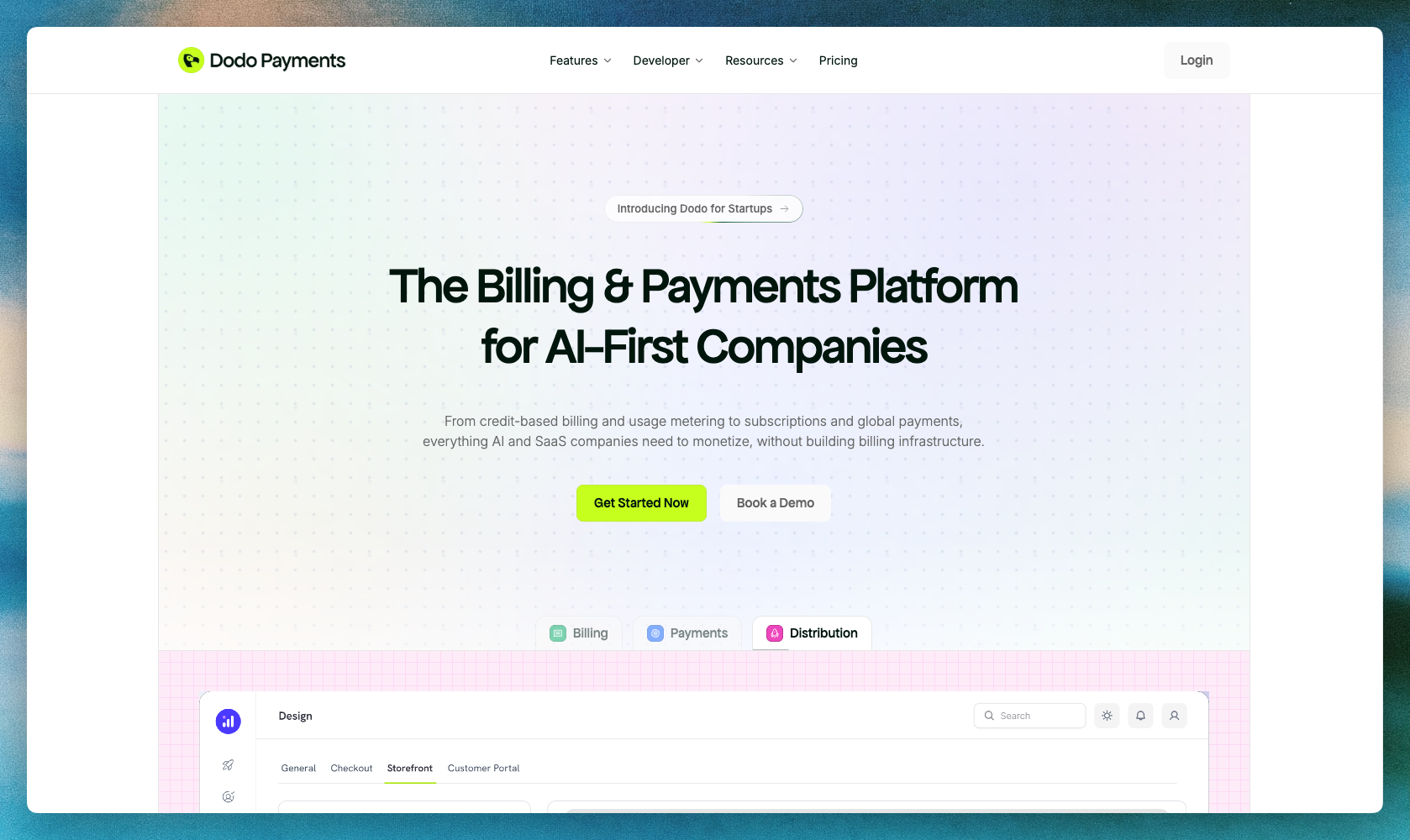
Dodo Payments explicitly positions itself as a Merchant of Record for SaaS, AI and digital products. Its official documentation says it serves 220+ countries and regions as the legal seller and handles payments, sales tax and VAT, fraud screening and chargebacks.
4.1 Rate Breakdown
US domestic cards and wallets: 4% + $0.40.
International cards: an extra 1.5%.
Subscriptions: an extra 0.5%.
PayPal or BNPL: an extra 3%.
Refunds: $1 per refund.
Disputes: $30 per dispute.
Standard payouts: usually free; $5 for a payout under $1,000; $25 for SWIFT to non-US businesses.
The headline rate "4% + $0.40" is just the starting point. Take a $49 international subscription as an example:
$49 × (4% + 1.5% + 0.5%) + $0.40 = $3.34
The effective rate is about 6.8%
Low-ticket businesses are more sensitive to fixed fees; once the international card and subscription surcharges stack up, they also raise the effective rate significantly.
4.2 Developer Experience Is the Main Selling Point
Dodo's toolchain is clearly aimed at developers and AI products:
Official server-side SDKs cover 9 languages.
The Billing SDK provides open-source React pricing tables and subscription management components.
Framework adapters and Checkout SDKs for Android, iOS, React Native and Flutter are available.
The Dodo CLI can manage payments, customers and webhooks, and supports local listening and testing.
An Agent Plugin, an MCP server and Agent Skills let AI coding assistants look up documentation and perform API operations.
The docs provide
llms.txt, and pages can also be read as Markdown.Usage-based billing supports token, credit and seat models, suitable for AI APIs and consumption-based SaaS.
Dodo discloses that it serves 50,000+ developers and covers 190+ tax jurisdictions, and offers a startup program with up to 12 months of credits; actual eligibility and amounts depend on the review result.
4.3 Boundaries to Confirm in Advance
Dodo is not "zero barrier". Your product must comply with the Merchant Acceptance Policy, and the applicant's identity document must come from an eligible country. Before integrating, developers in China should first confirm whether their identity documents, business type and settlement region meet the current policy.
It's an advantage that the MoR handles chargebacks, but that doesn't mean the account carries no risk. As the legal seller, the platform bears compliance responsibility, and it will also tighten risk controls when payment attempts look abnormal, the refund rate rises or the business model changes, which may limit collections or payouts. This is a mechanism common to all MoRs, not a problem unique to one of them.
V. Waffo Pancake: A Challenger Built for Indie Developers
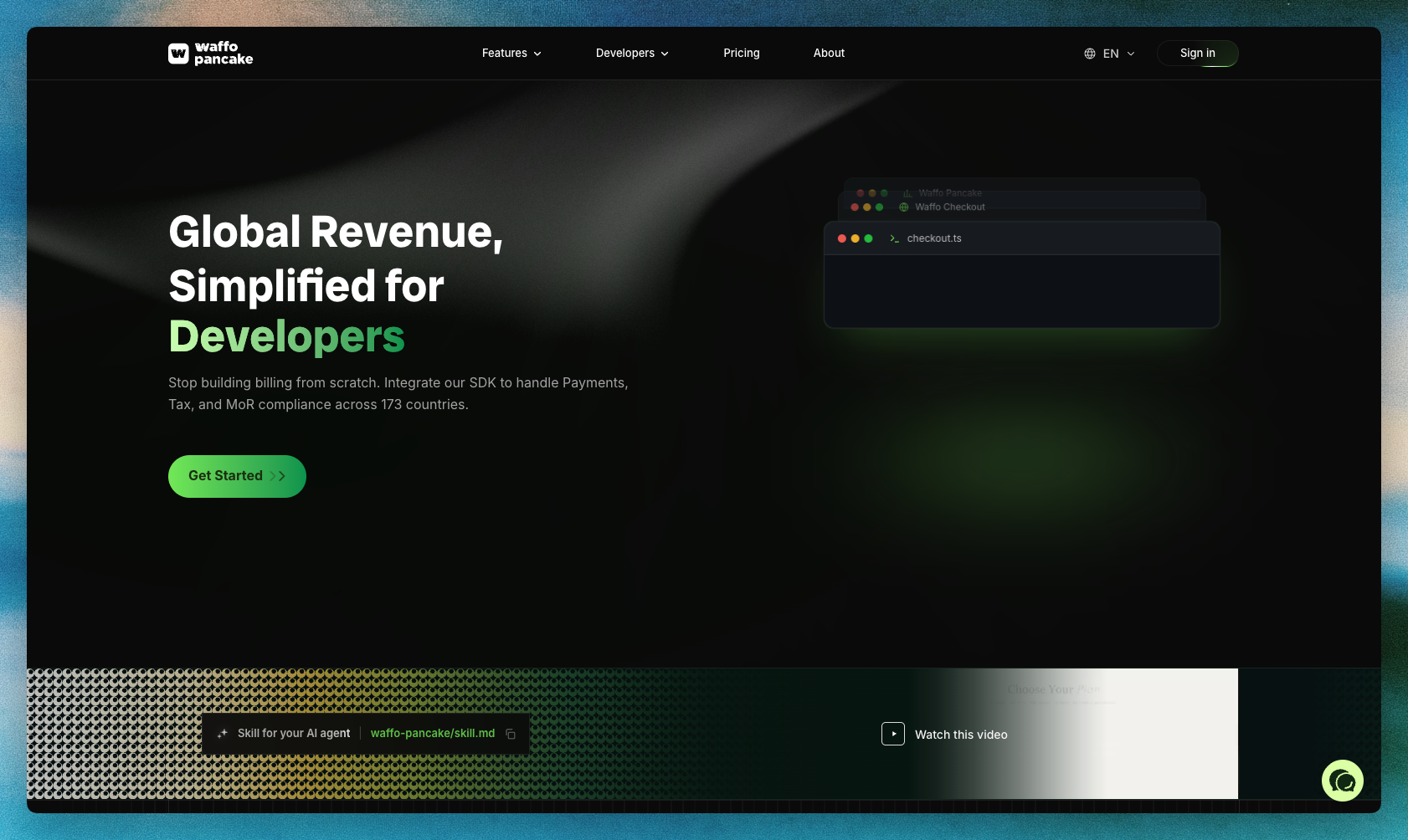
Waffo Pancake also uses the MoR model, but its positioning is more direct: let individual developers without a company entity collect global digital-product revenue too. The official Chinese documentation says "an individual identity is enough to collect payments, no company registration needed, funds go straight to the bank".
5.1 Rate Structure
Based on the public price list as of September 2026:
Cards and wallets: 3.9% + $0.50.
WeChat Pay: 3.9%, with no fixed fee.
Failed 3DS verification: $0.30 per attempt.
Refunds: $1.00 per refund, and the original transaction fee is not returned.
Payouts: 1% of the amount, with a minimum of $10 per payout.
First chargeback: $25; appeal: $10.
No monthly fee, no setup fee.
The key difference from Dodo is that there's no international card surcharge. When international subscriptions make up a large share, the fees on the transaction side may be lower than Dodo's; but Waffo's 1% payout fee is a second layer of take and must be included in the total cost. For low-volume accounts, the "$10 minimum per payout" also makes frequent payouts uneconomical.
5.2 Capabilities More Targeted at Chinese Developers
Individual onboarding: No need to register a company first; of the three, it's the most direct path for individual developers.
WeChat Pay: Clear differentiated value for Chinese consumers or overseas Chinese markets.
Local payments: Supports Apple Pay, Google Pay, USDC, PIX and 430+ local payment methods.
Global compliance: It says it covers 173 countries under the MoR model.
Checkout experience: A two-step checkout with 19 languages built in.
On the development side it provides a TypeScript SDK (@waffo/pancake-ts), REST and GraphQL APIs, webhooks, and an MCP Skill. Webhooks use RSA-SHA256 signatures. It also discloses that Adaptive 3DS has a frictionless pass rate of 92.4%; this figure should be understood as the platform's own measure, and you still need to measure it against your own customer base after integrating.
Waffo was founded in 2023 and is headquartered in Hong Kong. The advantage of a newer platform is usually that it's closer to indie developers and decides faster; correspondingly, merchants should also evaluate the platform's track record, settlement stability, support responsiveness and risk-control appeal process, not just the feature list.
VI. Head-to-Head Comparison
6.1 Comparison Across All Dimensions
Dimension | Stripe | Dodo Payments | Waffo Pancake |
|---|---|---|---|
Model | Payment processor | MoR | MoR |
Card rate | 2.9% + $0.30 | 4% + $0.40 | 3.9% + $0.50 |
International surcharge | +1.5% | +1.5% | None |
Subscription surcharge | Billing +0.7% | +0.5% | Not listed separately |
Payout fee | Varies by region/method | Standard usually free | 1%, minimum $10 |
Refund fee | Per regional price list | $1 | $1, transaction fee not returned |
Chargeback fee | From $15 | $30 | From $25 |
Tax coverage | Merchant handles it or buys add-on | 190+ jurisdictions | 173 countries as MoR |
KYC requirement | Entity in a supported region | Eligible identity document | Individual identity accepted |
WeChat Pay | Depends on account and region | Per official site | Supported |
Usage-based billing | Billing / Meters | Out of the box | Per official site |
Developer tools | Most complete ecosystem | SDK / CLI / MCP | TS / REST / GraphQL |
Note: In the table, Stripe uses US standard pricing; the specific rates for Dodo and Waffo vary with payment method, region, settlement route and contract. The basis for counting tax coverage also isn't identical.
6.2 Real-Cost Estimate for $10,000 Monthly Volume
Assumptions:
Monthly volume $10,000.
80% international cards, 20% US domestic cards.
All subscriptions, average ticket $50, 200 transactions in total.
Waffo consolidates payouts once a month.
Refunds, chargebacks, 3DS failures and currency conversion are not counted.
Platform | Monthly cost breakdown | Total | Share of volume |
|---|---|---|---|
Stripe | Processing 70 | $540 | 5.4% |
Dodo | Base 120 + subscription $50 | $650 | 6.5% |
Waffo | Transaction 100 | $590 | 5.9% |
The calculation is as follows:
Stripe
Domestic cards: $2,000 × 2.9% = $58
International cards: $8,000 × 4.4% = $352
Fixed fees: 200 × $0.30 = $60
Billing: $10,000 × 0.7% = $70
Total: $540

Dodo Payments
Base percentage fee: $10,000 × 4% = $400
Fixed fees: 200 × $0.40 = $80
International card surcharge: $8,000 × 1.5% = $120
Subscription surcharge: $10,000 × 0.5% = $50
Total: $650

Waffo Pancake
Transaction percentage fee: $10,000 × 3.9% = $390
Fixed fees: 200 × $0.50 = $100
Payout fee: $10,000 × 1% = $100
Total: $590
These numbers illustrate two things:
Headline rates are misleading. Dodo's 4%, Waffo's 3.9% and Stripe's 2.9% are none of them the final cost.
Stripe's $540 and a MoR's fees are not the same product. The Stripe figure still excludes tax registration, filing, compliance tools and the labor involved; Dodo's and Waffo's fees include MoR services.
Conclusion: What you should really compare is the total cost of ownership: "transaction fee + international surcharge + subscription surcharge + payout fee + tax compliance + risk losses".
The above are estimates only; the actual figures depend on the official price list, contract, payment method and account region.
VI. Creem: A Flat-Rate MoR Challenger
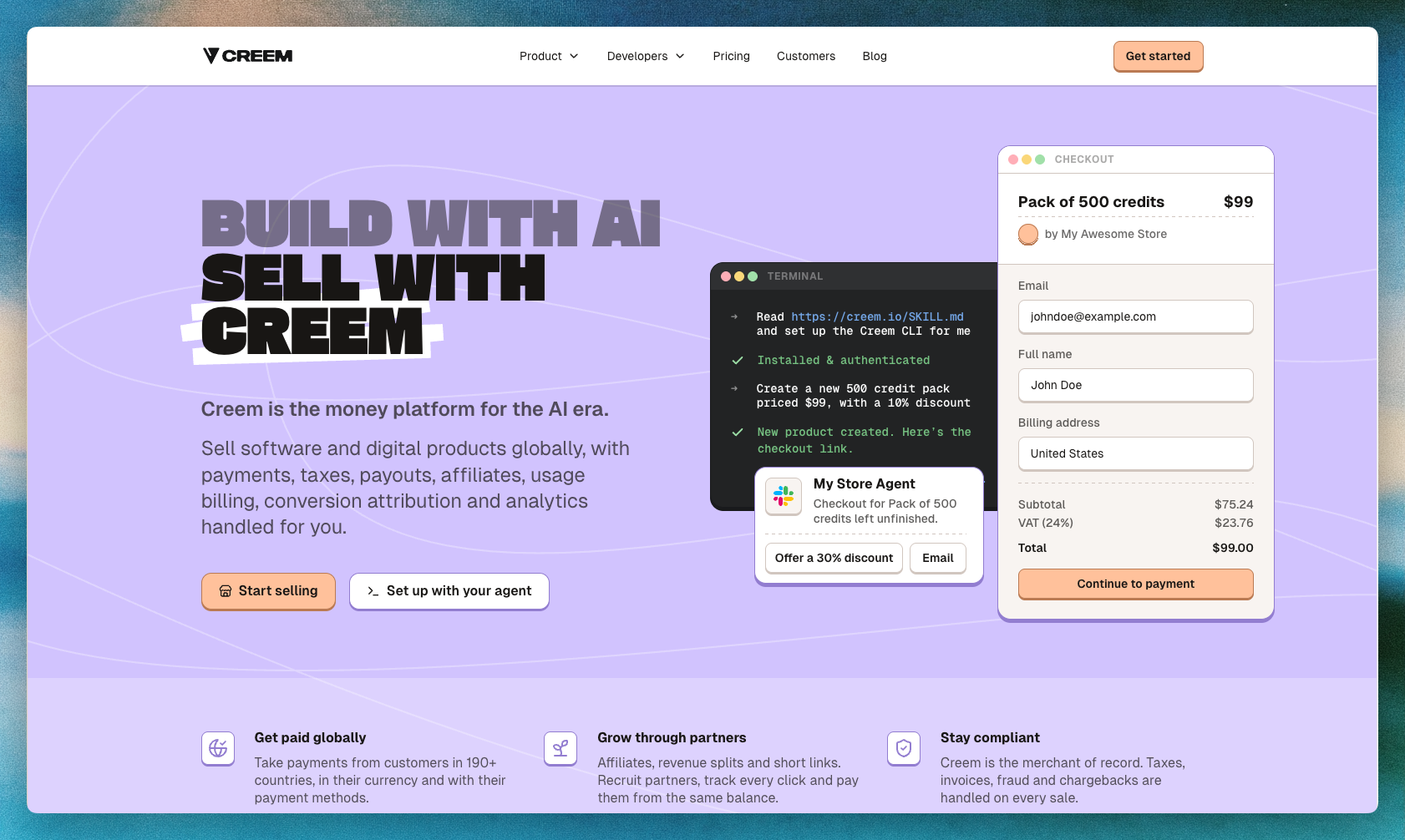
Creem (launched in 2024, operated by Armitage Labs OU of Estonia) also uses the MoR model, and its slogan is "Build with AI. Sell with Creem.". Its play is direct: a flat rate with no surcharges at all, aimed at global payments for indie developers and AI products.
6.1 Rates: The Flat Rate Is the Biggest Selling Point
All successful transactions: 3.9% + $0.40, the same price for one-time payments and subscriptions, for all card types and all countries.
No monthly fee, no setup fee, no minimum volume; custom pricing can be negotiated for large customers.
Compared with Dodo: it drops the international card +1.5% and the subscription +0.5%; compared with Waffo: there's no 1% payout cut (payouts happen on the 1st and 15th of each month, to a bank account or a USDC wallet).
Refunds and chargebacks are handled primarily by Creem as the MoR; the specific fees follow the official site.
For the same $49 international subscription:
$49 × 3.9% + $0.40 = $2.31
The effective rate is about 4.7%
In the same scenario Dodo's transaction fee is 2.81, plus payout fees. Creem's flat rate is the lowest transaction cost of the four under the "international cards + subscription" combination.
6.2 Growth Tools Are the Differentiator
Creem builds into the platform capabilities that you would normally need third-party plugins for:
Affiliates: Built-in affiliate tracking, with commissions configurable per product and per partner and settled automatically.
Revenue splits: Revenue is split automatically among co-founders, partners or contractors, with no manual reconciliation.
Credit wallets and usage-based billing: Prepaid credit packs (with automatic top-ups), or custom meters that measure by tokens, number of calls or minutes, ready to use for AI products.
License keys: Automatic generation and delivery of software license keys.
42 checkout languages, with custom-domain checkout; iOS / Android apps come with real-time push notifications.
Payment methods cover Visa, Mastercard, Amex, Discover, Apple Pay, Google Pay and some local payment methods; WeChat Pay and Alipay are officially marked as coming soon — a clear weakness relative to Waffo.
6.3 Developer Experience
TypeScript SDK, Next.js Adapter, and a CLI (installed via Homebrew, with JSON output and an interactive TUI).
SKILL.md: one sentence to an AI coding assistant is enough to get integrated ("Read https://creem.io/SKILL.md and set up Creem for me"), a rarely seen AI-native approach among MoRs.
Provides a one-click migration tool from LemonSqueezy.
It says 3,000+ teams already use it; on tax coverage, the homepage says 190+ countries while the pricing page says 50+ countries (including 28+ US states, EU Estonia OSS, the UK and South Korea). The figures are inconsistent, so confirm with the official site before signing up.
6.4 Boundaries to Confirm in Advance
Does not accept marketplaces, physical goods, adult content and deepfake tools — it is positioned for pure software/digital products, with clearer category restrictions than Dodo/Waffo.
New payments carry a 7–12 day risk hold (clearly noted in the dashboard); leave plenty of room in your cash-flow expectations, as this is a real cost for a small team's working capital.
Launched in 2024, its track record is shorter than established players like Paddle; large-scale dispute handling, appeal responsiveness and long-term settlement stability still need time to be proven.
Individuals or businesses can both apply, with no minimum volume; the onboarding barrier is close to Waffo's.
The official site says Alipay and WeChat Pay are coming soon. If your main users are in China and you care about Alipay and WeChat, you may want to check back in a while.
VII. Head-to-Head Comparison
7.1 Comparison Across All Dimensions
Dimension | Stripe | Dodo Payments | Waffo Pancake | Creem |
|---|---|---|---|---|
Model | Payment processor | MoR | MoR | MoR |
Card rate | 2.9% + $0.30 | 4% + $0.40 | 3.9% + $0.50 | 3.9% + $0.40 (flat rate) |
International surcharge | +1.5% | +1.5% | None | None |
Subscription surcharge | Billing +0.7% | +0.5% | Not listed separately | None (flat rate) |
Payout fee | Varies by region/method | Standard usually free | 1%, minimum $10 | 1st and 15th of each month, to a bank or USDC |
Refund fee | Per regional price list | $1 | $1, transaction fee not returned | Per official site |
Chargeback fee | From $15 | $30 | From $25 | Per official site |
Tax coverage | Merchant handles it or buys add-on | 190+ jurisdictions | 173 countries as MoR | 190+ countries (50+ per the pricing page; confirm with the official site) |
KYC requirement | Entity in a supported region | Eligible identity document | Individual identity accepted | Individuals or businesses |
WeChat Pay | Depends on account and region | Per official site | Supported | Not yet live (coming soon) |
Usage-based billing | Billing / Meters | Out of the box | Per official site | Credit wallets / custom meters |
Developer tools | Most complete ecosystem | SDK / CLI / MCP | TS / REST / GraphQL | TS SDK / CLI / SKILL.md |
Affiliates / revenue splits | — | Per official site | Not listed separately | Built-in Affiliates + Revenue splits |
Note: In the table, Stripe uses US standard pricing; the specific rates for Dodo and Waffo vary with payment method, region, settlement route and contract. The basis for counting tax coverage also isn't identical.
7.2 Real-Cost Estimate for $10,000 Monthly Volume
Assumptions:
Monthly volume $10,000.
80% international cards, 20% US domestic cards.
All subscriptions, average ticket $50, 200 transactions in total.
Waffo consolidates payouts once a month.
Refunds, chargebacks, 3DS failures and currency conversion are not counted.
Platform | Monthly cost breakdown | Total | Share of volume |
|---|---|---|---|
Stripe | Processing 70 | $540 | 5.4% |
Dodo | Base 120 + subscription $50 | $650 | 6.5% |
Waffo | Transaction 100 | $590 | 5.9% |
Creem | Transaction $470 | $470 | 4.7% |
The calculation is as follows:
Stripe
Domestic cards: $2,000 × 2.9% = $58
International cards: $8,000 × 4.4% = $352
Fixed fees: 200 × $0.30 = $60
Billing: $10,000 × 0.7% = $70
Total: $540

Dodo Payments
Base percentage fee: $10,000 × 4% = $400
Fixed fees: 200 × $0.40 = $80
International card surcharge: $8,000 × 1.5% = $120
Subscription surcharge: $10,000 × 0.5% = $50
Total: $650

Waffo Pancake
Transaction percentage fee: $10,000 × 3.9% = $390
Fixed fees: 200 × $0.50 = $100
Payout fee: $10,000 × 1% = $100
Total: $590

Creem
Transaction percentage fee: $10,000 × 3.9% = $390
Fixed fees: 200 × $0.40 = $80
Total: $470
These numbers illustrate two things:
Headline rates are misleading. Dodo's 4%, Waffo's 3.9% and Stripe's 2.9% are none of them the final cost.
Stripe's $540 and a MoR's fees are not the same product. The Stripe figure still excludes tax registration, filing, compliance tools and the labor involved; Dodo's and Waffo's fees include MoR services.
Conclusion: What you should really compare is the total cost of ownership: "transaction fee + international surcharge + subscription surcharge + payout fee + tax compliance + risk losses".
The above are estimates only; the actual figures depend on the official price list, contract, payment method and account region.
VIII. Practical Choices for Chinese Indie Developers
8.1 Stripe: Sort Out the Entity First, Then Talk Technology
If you already have a compliant company entity in a region Stripe supports (the US, Singapore, Hong Kong, etc.) and have accounting and tax resources, Stripe can usually offer the strongest ecosystem, the most room for customization and long-term scalability.
If you don't have an overseas entity yet and register a company on the spot just to use Stripe, you need to count registration fees, annual maintenance, bank accounts, tax filing and document updates as real costs. Having the payment API connected doesn't mean the business loop is complete.
8.2 Dodo: Check the Eligible Country First
Dodo can take on the MoR responsibilities for developers, and is especially suited to AI SaaS, usage-based billing and teams that want global tax coverage quickly. But before investing in integration, first check that your identity document comes from a currently eligible country and confirm that your business complies with the Merchant Acceptance Policy.
8.3 Waffo: Individual Onboarding and WeChat Pay Are the Core Value
Waffo's appeal to individual developers in China is the clearest: individuals can apply, there's no need to register a company first, and WeChat Pay is supported. The price is that payouts are charged at 1% with a minimum of $10 each, so it suits consolidated payouts better than small, frequent settlements.
8.4 Creem: Flat Rate and Growth Tools
Creem's flat 3.9% + $0.40 is the lowest transaction cost of the four under the "international cards + subscription" combination, and it has built-in affiliate and revenue-split features, which suits products that grow through partners. Note two things: WeChat Pay / Alipay aren't live yet (marked coming soon on the official site), so it is less suited than Waffo to Chinese-speaking markets; and new payments carry a 7–12 day risk hold, so leave plenty of room in your cash-flow expectations. Individuals or businesses can both apply, with no minimum volume.
8.5 Calculate with a Three-Variable Model Instead of Choosing by Feel
Build your own business forecast sheet with at least three input variables:
Share of international cards: The higher it is, the more the international card surcharge matters.
Share of subscriptions: The higher it is, the more Billing or the subscription surcharge matters.
Payout frequency: The higher it is, the more the fixed payout fee or minimum charge matters.
Then add average ticket size, refund rate, chargeback rate and currency-conversion share, and only then can you get a unit-economics model close to reality.
IX. Risk Control: The Battlefield You Can't See
9.1 Why Card-Testing Attacks Are Dangerous
Card testing is when fraudsters use a merchant's Checkout to verify in bulk whether stolen cards are valid. Common signals include:
A large number of small payments or failed authorizations in a short time.
The same IP, device or email pattern repeatedly switching card numbers.
Quick refunds right after successful payments, or a burst of chargebacks afterward.
A new business with no organic traffic suddenly seeing abnormally frequent requests.
Card testing doesn't just generate payment and 3DS costs; it also raises your chargeback rate and triggers card-network monitoring, and in serious cases the platform may suspend collections or payouts. A MoR handling chargebacks doesn't mean the merchant can ignore the security of the entry point.
9.2 The Minimum Risk-Control Baseline Before Launch
Enable rate limiting: Limit how often Checkout can be created, per IP, device, account and payment method.
Protect public endpoints: Checkout Sessions must be created by the server, so that the amount, currency and product information can't be tampered with on the front end.
Use 3DS: Trigger 3DS for high-risk regions, abnormal devices and high-value transactions, rather than forcing it indiscriminately.
Monitor failure rates: Set automatic alerts on authorization failure rate, refund rate and chargeback rate.
Verify webhooks: Check signatures, use idempotency keys, and deliver digital entitlements only after the server has confirmed the payment.
Prepare KYC in full: Prepare proof of company or individual identity, product description, terms of service, refund policy and fulfillment evidence all at once.
Keep audit records: Keep records of orders, logins, delivery, downloads and customer-support conversations so you can handle disputes.
The goal of payment risk control isn't to "stop every bad actor" but to find a sustainable balance among conversion rate, fraud losses and account stability.
X. Decision Checklist
Do a first-pass screen in the following order:
Have an overseas company entity, a strong technical team and need deep customization → evaluate Stripe first.
No company entity and want to start selling globally as fast as possible → evaluate a MoR first.
High share of international subscriptions, infrequent payouts → Waffo Pancake's lack of an international surcharge may work out better.
AI product that needs token, credit or seat usage-based billing → Dodo Payments' ready-made toolchain saves more engineering effort.
High share of international subscriptions, want a flat rate, need affiliates/revenue splits → Creem.
Individual developer in China who wants WeChat Pay support → evaluate Waffo Pancake first (Creem's WeChat Pay is still coming soon).
Also run four reverse checks:
Does the platform accept your identity documents and region of registration?
Does your product category comply with the Merchant Acceptance Policy?
If review, a freeze or a dispute occurs, is there a clear appeal channel?
If your main payment platform suspends service, do you have a backup way to collect payments or migrate data?
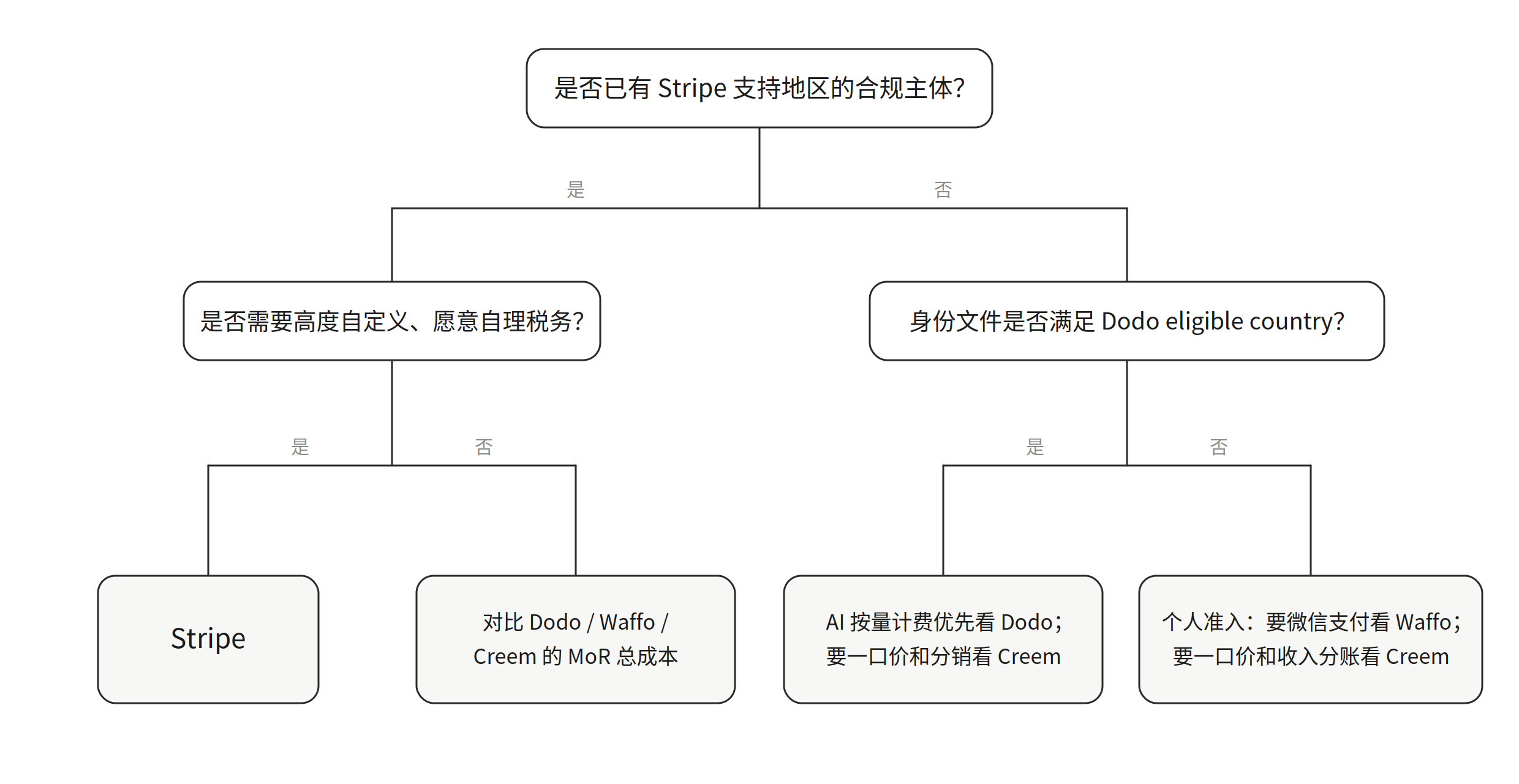
Minimal decision tree:
XI. Afterword
Stripe, Dodo Payments, Waffo Pancake and Creem represent four different sets of priorities:
Stripe: The strongest ecosystem and the deepest customizability, but heavier entity and compliance responsibilities.
Dodo Payments: A combination of outsourced MoR compliance and AI billing tools, suited to technical SaaS teams.
Waffo Pancake: Individual onboarding, no international card surcharge and WeChat Pay make it friendlier to Chinese indie developers.
Creem: An all-inclusive flat 3.9% + $0.40, the lowest transaction cost for international subscriptions, built-in affiliates and revenue splits; WeChat Pay isn't live yet, and the platform's track record is shorter.
There's no absolutely best payment platform, only the allocation of responsibility that best fits your current stage. In the early days the most important thing is to get your first global revenue as quickly and compliantly as possible; once you scale, redesign around success rate, cost, settlement and risk-control redundancy.
Rates and onboarding policies change. Before integrating, recalculate with your own share of international cards, share of subscriptions, average ticket, refund rate and payout frequency, and rely on the latest official price list and review results.
I'm currently using Dodo and Waffo for real, and Creem is still under review. Personally, Dodo gives me the best impression and experience so far, far ahead of Waffo in both features and UI — maybe it's just that I prefer a minimalist style, and I'm still getting used to Waffo's overly intense geek style.
A few more things worth knowing:
Dodo's payouts go to a bank card; it doesn't support payouts directly to Alipay. Waffo, however, supports payouts directly to Alipay.
Dodo and Creem support meters and an integrated license-hosting system. Waffo doesn't support metering: it currently offers only one-time payments and subscriptions, and the license mechanism has to be implemented on your own server.
WeChat Pay on both Dodo and Waffo currently doesn't support subscriptions; it can only be used for one-time payments.
Whichever platform you choose, be sure to put rate limiting and security measures in place to avoid attacks such as card testing. My Dodo account was hit by a card-testing attack and the platform banned it outright, and it's still being negotiated. This is an issue developers should take seriously: don't assume that by choosing a platform you can leave all of this security work to it. When something goes wrong, the merchant's loss is always the biggest. Remember that!!
An update on the Dodo ban on my merchant account: the final outcome is in. I received an email from them saying my account has been restored. They said the ban had been meant to keep the attack from continuing and causing me losses, and they were also willing to give $500 in credits as compensation. Overall I'm fairly satisfied with the result, and it was a lesson learned the hard way: whatever platform you use, put protections in place and don't rely on the platform to catch you.
Official Resources
Copyright
Copyright of this article belongs to its author or rights holder. When reposting or quoting, please follow the applicable license terms and keep the link to this article.
Link to this article: https://xuyi.dev/en/2026-10-05-cilb3k